 Add to Chrome
 Add to Firefox
 Add to Edge
Food Recognition
Food recognition is the process of identifying and categorizing different types of food in images or videos.
Papers and Code
Pest-Thinker: Learning to Think and Reason like Entomologists via Reinforcement Learning
May 07, 2026
Pest-induced crop losses pose a major threat to global food security and sustainable agricultural development. While recent advances in Multimodal Large Language Models (MLLMs) have shown strong potential for visual understanding and smart agriculture, their direct application to pest recognition remains limited due to the domain's unique challenges such as high inter-species complexity, intra-species variability, and the scarcity of expert-annotated data. In this work, we introduce Pest-Thinker, a knowledge-driven reinforcement learning (RL) framework that enables MLLMs to reason over fine-grained pest morphology. We first construct two high-definition pest benchmarks, QFSD and AgriInsect, comprising diverse species and expert-annotated morphological traits. Leveraging these datasets, we synthesize Chain-of-Thought (CoT) reasoning trajectories to facilitate structured learning of pest-specific visual cues through Supervised Fine-Tuning (SFT). Subsequently, we employ Group Relative Policy Optimization (GRPO) with a novel feature reward that guides the model to focus on observable morphological evidence, assessed by an LLM-as-a-Judge strategy. Extensive experiments demonstrate that Pest-Thinker substantially improves both in-domain and out-of-domain morphological understanding, marking a step toward expert-level visual reasoning for intelligent agricultural pest analysis. The datasets and source code are available upon acceptance.

FoodSense: A Multisensory Food Dataset and Benchmark for Predicting Taste, Smell, Texture, and Sound from Images
Apr 15, 2026Humans routinely infer taste, smell, texture, and even sound from food images a phenomenon well studied in cognitive science. However, prior vision language research on food has focused primarily on recognition tasks such as meal identification, ingredient detection, and nutrition estimation. Image-based prediction of multisensory experience remains largely unexplored. We introduce FoodSense, a human-annotated dataset for cross-sensory inference containing 66,842 participant-image pairs across 2,987 unique food images. Each pair includes numeric ratings (1-5) and free-text descriptors for four sensory dimensions: taste, smell, texture, and sound. To enable models to both predict and explain sensory expectations, we expand short human annotations into image-grounded reasoning traces. A large language model generates visual justifications conditioned on the image, ratings, and descriptors. Using these annotations, we train FoodSense-VL, a vision language benchmark model to produce both multisensory ratings and grounded explanations directly from food images. This work connects cognitive science findings on cross-sensory perception with modern instruction tuning for multimodal models and shows that many popular evaluation metrics are insufficient for visually sensory inference.
Dual-Imbalance Continual Learning for Real-World Food Recognition
Mar 31, 2026Visual food recognition in real-world dietary logging scenarios naturally exhibits severe data imbalance, where a small number of food categories appear frequently while many others occur rarely, resulting in long-tailed class distributions. In practice, food recognition systems often operate in a continual learning setting, where new categories are introduced sequentially over time. However, existing studies typically assume that each incremental step introduces a similar number of new food classes, which rarely happens in real world where the number of newly observed categories can vary significantly across steps, leading to highly uneven learning dynamics. As a result, continual food recognition exhibits a dual imbalance: imbalanced samples within each food class and imbalanced numbers of new food classes to learn at each incremental learning step. In this work, we introduce DIME, a Dual-Imbalance-aware Adapter Merging framework for continual food recognition. DIME learns lightweight adapters for each task using parameter-efficient fine-tuning and progressively integrates them through a class-count guided spectral merging strategy. A rank-wise threshold modulation mechanism further stabilizes the merging process by preserving dominant knowledge while allowing adaptive updates. The resulting model maintains a single merged adapter for inference, enabling efficient deployment without accumulating task-specific modules. Experiments on realistic long-tailed food benchmarks under our step-imbalanced setup show that the proposed method consistently improves by more than 3% over the strongest existing continual learning baselines. Code is available at https://github.com/xiaoyanzhang1/DIME.
Continual Learning for Food Category Classification Dataset: Enhancing Model Adaptability and Performance
Mar 20, 2026Conventional machine learning pipelines often struggle to recognize categories absent from the original trainingset. This gap typically reduces accuracy, as fixed datasets rarely capture the full diversity of a domain. To address this, we propose a continual learning framework for text-guided food classification. Unlike approaches that require retraining from scratch, our method enables incremental updates, allowing new categories to be integrated without degrading prior knowledge. For example, a model trained on Western cuisines could later learn to classify dishes such as dosa or kimchi. Although further refinements are needed, this design shows promise for adaptive food recognition, with applications in dietary monitoring and personalized nutrition planning.
Enhanced Food Category Recognition under Illumination-Induced Domain Shift
Feb 09, 2026Visual food recognition systems deployed in real-world environments, such as automated conveyor-belt inspection, are highly sensitive to domain shifts caused by illumination changes. While recent studies have shown that lighting variations can significantly distort food perception by both humans and AI, existing works are often limited to single food categories or controlled settings, and most public food datasets lack explicit illumination annotations. In this work, we investigate illumination-induced domain shift in multi-class food category recognition using two widely adopted datasets, Food-101 and Fruits-360. We demonstrate substantial accuracy degradation under cross-dataset evaluation due to mismatched visual conditions. To address this challenge, we construct synthetic illumination-augmented datasets by systematically varying light temperature and intensity, enabling controlled robustness analysis without additional labels. We further evaluate cross-dataset transfer learning and domain generalization, with a focus on illumination-sensitive target categories such as apple-based classes. Experimental results show that illumination-aware augmentation significantly improves recognition robustness under domain shift while preserving real-time performance. Our findings highlight the importance of illumination robustness and provide practical insights for deploying reliable food recognition systems in real-world inspection scenarios.
Mam-App: A Novel Parameter-Efficient Mamba Model for Apple Leaf Disease Classification
Jan 29, 2026The rapid growth of the global population, alongside exponential technological advancement, has intensified the demand for food production. Meeting this demand depends not only on increasing agricultural yield but also on minimizing food loss caused by crop diseases. Diseases account for a substantial portion of apple production losses, despite apples being among the most widely produced and nutritionally valuable fruits worldwide. Previous studies have employed machine learning techniques for feature extraction and early diagnosis of apple leaf diseases, and more recently, deep learning-based models have shown remarkable performance in disease recognition. However, most state-of-the-art deep learning models are highly parameter-intensive, resulting in increased training and inference time. Although lightweight models are more suitable for user-friendly and resource-constrained applications, they often suffer from performance degradation. To address the trade-off between efficiency and performance, we propose Mam-App, a parameter-efficient Mamba-based model for feature extraction and leaf disease classification. The proposed approach achieves competitive state-of-the-art performance on the PlantVillage Apple Leaf Disease dataset, attaining 99.58% accuracy, 99.30% precision, 99.14% recall, and a 99.22% F1-score, while using only 0.051M parameters. This extremely low parameter count makes the model suitable for deployment on drones, mobile devices, and other low-resource platforms. To demonstrate the robustness and generalizability of the proposed model, we further evaluate it on the PlantVillage Corn Leaf Disease and Potato Leaf Disease datasets. The model achieves 99.48%, 99.20%, 99.34%, and 99.27% accuracy, precision, recall, and F1-score on the corn dataset and 98.46%, 98.91%, 95.39%, and 97.01% on the potato dataset, respectively.
Deep Learning-Based Image Recognition for Soft-Shell Shrimp Classification
Jan 06, 2026With the integration of information technology into aquaculture, production has become more stable and continues to grow annually. As consumer demand for high-quality aquatic products rises, freshness and appearance integrity are key concerns. In shrimp-based processed foods, freshness declines rapidly post-harvest, and soft-shell shrimp often suffer from head-body separation after cooking or freezing, affecting product appearance and consumer perception. To address these issues, this study leverages deep learning-based image recognition for automated classification of white shrimp immediately after harvest. A convolutional neural network (CNN) model replaces manual sorting, enhancing classification accuracy, efficiency, and consistency. By reducing processing time, this technology helps maintain freshness and ensures that shrimp transportation businesses meet customer demands more effectively.
SignIT: A Comprehensive Dataset and Multimodal Analysis for Italian Sign Language Recognition
Dec 16, 2025In this work we present SignIT, a new dataset to study the task of Italian Sign Language (LIS) recognition. The dataset is composed of 644 videos covering 3.33 hours. We manually annotated videos considering a taxonomy of 94 distinct sign classes belonging to 5 macro-categories: Animals, Food, Colors, Emotions and Family. We also extracted 2D keypoints related to the hands, face and body of the users. With the dataset, we propose a benchmark for the sign recognition task, adopting several state-of-the-art models showing how temporal information, 2D keypoints and RGB frames can be influence the performance of these models. Results show the limitations of these models on this challenging LIS dataset. We release data and annotations at the following link: https://fpv-iplab.github.io/SignIT/.
Evaluating Gemini LLM in Food Image-Based Recipe and Nutrition Description with EfficientNet-B4 Visual Backbone
Nov 11, 2025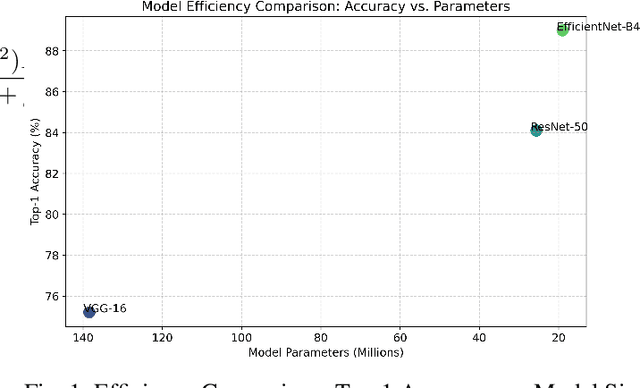
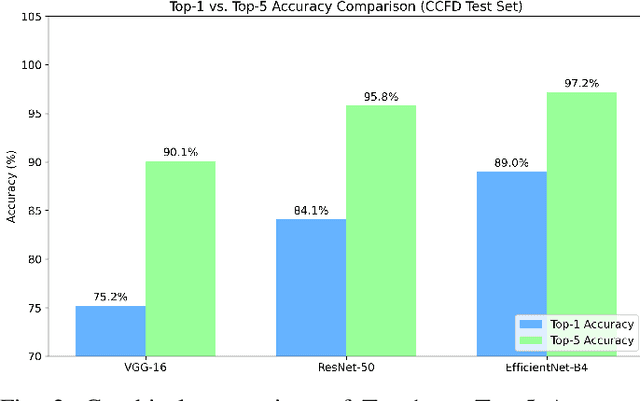
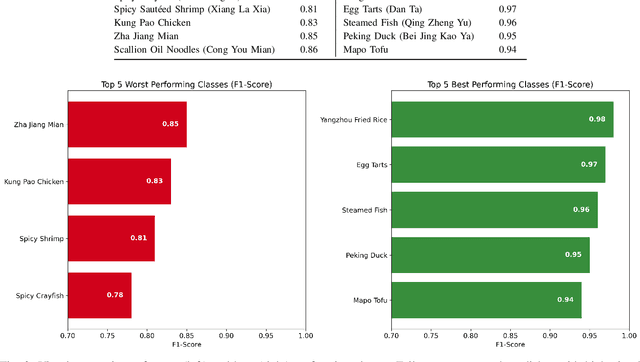
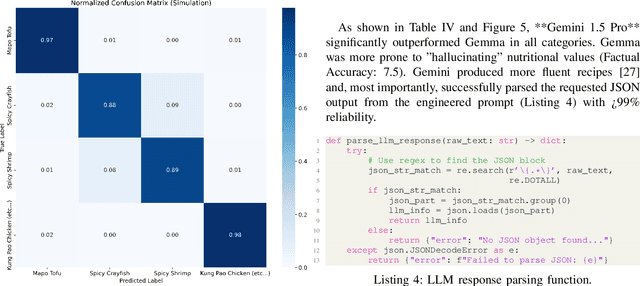
The proliferation of digital food applications necessitates robust methods for automated nutritional analysis and culinary guidance. This paper presents a comprehensive comparative evaluation of a decoupled, multimodal pipeline for food recognition. We evaluate a system integrating a specialized visual backbone (EfficientNet-B4) with a powerful generative large language model (Google's Gemini LLM). The core objective is to evaluate the trade-offs between visual classification accuracy, model efficiency, and the quality of generative output (nutritional data and recipes). We benchmark this pipeline against alternative vision backbones (VGG-16, ResNet-50, YOLOv8) and a lightweight LLM (Gemma). We introduce a formalization for "Semantic Error Propagation" (SEP) to analyze how classification inaccuracies from the visual module cascade into the generative output. Our analysis is grounded in a new Custom Chinese Food Dataset (CCFD) developed to address cultural bias in public datasets. Experimental results demonstrate that while EfficientNet-B4 (89.0\% Top-1 Acc.) provides the best balance of accuracy and efficiency, and Gemini (9.2/10 Factual Accuracy) provides superior generative quality, the system's overall utility is fundamentally bottlenecked by the visual front-end's perceptive accuracy. We conduct a detailed per-class analysis, identifying high semantic similarity as the most critical failure mode.
What's on Your Plate? Inferring Chinese Cuisine Intake from Wearable IMUs
Nov 07, 2025Accurate food intake detection is vital for dietary monitoring and chronic disease prevention. Traditional self-report methods are prone to recall bias, while camera-based approaches raise concerns about privacy. Furthermore, existing wearable-based methods primarily focus on a limited number of food types, such as hamburgers and pizza, failing to address the vast diversity of Chinese cuisine. To bridge this gap, we propose CuisineSense, a system that classifies Chinese food types by integrating hand motion cues from a smartwatch with head dynamics from smart glasses. To filter out irrelevant daily activities, we design a two-stage detection pipeline. The first stage identifies eating states by distinguishing characteristic temporal patterns from non-eating behaviors. The second stage then conducts fine-grained food type recognition based on the motions captured during food intake. To evaluate CuisineSense, we construct a dataset comprising 27.5 hours of IMU recordings across 11 food categories and 10 participants. Experiments demonstrate that CuisineSense achieves high accuracy in both eating state detection and food classification, offering a practical solution for unobtrusive, wearable-based dietary monitoring.The system code is publicly available at https://github.com/joeeeeyin/CuisineSense.git.